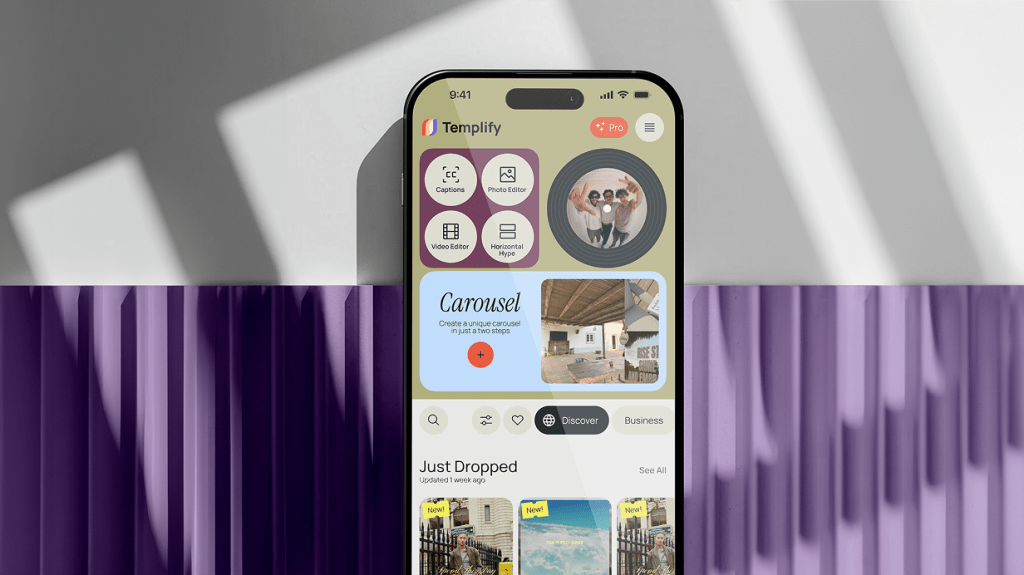
How Templify automated nearly half of customer support and cut tooling costs by 89%.
AI-native customer support and automated subscription management. 89% reduction in tooling costs, 48% of tickets fully automated, and 5.900% faster response times.


A cloud-native application assumes the cloud in its architecture: built that way, it ships faster, absorbs traffic spikes, and costs less to run. The same software parked on a cloud server rarely manages any of it.
Automation and CI/CD pipelines turn every release into a routine event your team barely notices.
Without them, shipping an update means a manual build and someone staying late again.
Cloud computing adds capacity when demand climbs and takes it back when the peak passes.
Software moved over as-is usually hits a ceiling that only a rewrite can raise.
Redundancy and failover keep the product answering requests while a zone recovers underneath it.
A single instance and a single database mean one bad afternoon takes everything offline.
Cloud infrastructure follows the usage you actually have, instead of hardware bought upfront.
Fixed capacity sized for the busiest day of the year is idle most days.
Encryption and access control follow cloud security best practices from the architecture stage onward.
Bolting security on after launch usually means living with the access model you already shipped.
Modular services and documented APIs keep the next integration small and scoped.
In a tangled codebase, adding one feature means touching parts nobody wants to open.
Business needs and workload assessment; cloud strategy and platform selection; architecture designed to scale, decisions made before any building starts
Cloud apps built from scratch; frontend, backend, databases, APIs; cloud infrastructure underneath; one build, no separate handoffs
Audit of current applications and data; migration with minimal disruption; modernization where it makes sense; no lift-and-shift of outdated patterns
Provisioning and configuration; monitoring and issue response, scaling as usage changes; cost efficiency over time
Connections to internal systems; third-party platforms and services; secure API design and development; database and data flow integration
Access control for cloud applications; data protection and encryption; compliance configured for the cloud; ongoing security monitoring

Ekreative has delivered 250+ digital products across healthcare, finance, retail, and SaaS. The work spans cloud platforms built from scratch, legacy systems re-architected for the cloud, and zero-downtime migrations. Each cloud solution starts from a different architecture problem, and results are measured in operational terms. The examples below are a selection from that work.
AI-native customer support and automated subscription management. 89% reduction in tooling costs, 48% of tickets fully automated, and 5.900% faster response times.
AI orchestration across customer support, content moderation, and ops. Same business outcomes, 58% smaller team, fully documented handover.
AI-augmented engineering practice across architecture, code generation, testing, and review. Faster delivery on a smaller team, in a regulated healthcare environment.
Engineering velocity overhaul on a legacy codebase: AI-augmented development workflow, automated QA, and refactored architecture. Real AI in the build process — not in the pitch deck.
Send us the shape of it: what you are building or modernizing, the application and infrastructure you run today, the users and workload you expect, and your preferred cloud provider if that decision is already made.
Pre-discovery is free. You get requirements, architecture, integrations, a timeline and an estimate — a wide range at this stage, and we will say so rather than pretend otherwise. No obligation, no long call.
Estimated value of senior engineering time included in every audit. Yours free, whether you hire us or not.
Cloud application development solutions get shaped by the data, the regulation, and the traffic behind them.
Patient platforms and clinical systems where access rules shape the architecture before anything else does.
Storefronts and checkouts that stay fast when a campaign pushes traffic far past normal.
Equipment catalogues and ordering platforms that stay fast when suppliers push a seasonal promotion.
Mobile-first products with subscription billing and steep seasonal swings in active user numbers.
Transaction workflows and data-intensive platforms where every integration carries an audit requirement.
Quoting and claims processing that integrate with carrier systems and established back-office platforms.
Production tracking and operational dashboards fed by equipment that never stops sending data.
Field and dispatch platforms that keep working when crews are offline and sync when they reconnect.
Don’t see your
industry?
Our cloud technologies span the application layer, infrastructure, databases, integrations, deployment tooling and cloud platforms — AWS (EC2, ECS, Lambda, S3, RDS, SQS/SNS, SES), Google Cloud, Vercel and Cloudflare, Supabase and Firebase, Terraform, Docker and Kubernetes, GitHub Actions or GitLab CI. That is where most of our work sits, not where it stops: whatever cloud provider your product runs on, we have almost certainly worked with it.
Picking a cloud application development company is mostly due diligence: who writes the code, how architecture decisions get made, and who is still around six months after launch. Here are our answers.
We design architecture for the cloud from the start. Scalability, resilience, and deployment patterns get decided while they are still cheap to change, instead of being retrofitted once traffic exposes the gaps.
Architecture begins with your users, product goals, expected usage, business workflows, and growth plans. Technology choices come after those answers, so the product is never bent to fit a stack someone picked early.
We select cloud services and architecture according to the workload in front of us. A data-heavy platform and a high-transaction product need different building blocks, and we size each one accordingly.
Automated testing, deployment pipelines, environment consistency, monitoring, and operational readiness are built during development. By launch day the pipeline has already run hundreds of times, so releasing becomes routine rather than an event.
Modular architecture, APIs, structured data flows, and extensible infrastructure keep options open. Adding integrations, automation, analytics, or AI capabilities later stays a scoped piece of work instead of a second rebuild.
Strategy, UX/UI, software development, cloud architecture, QA, deployment, and support stay inside one development team. Handoffs drop, and nobody has to re-explain the product to a vendor who just joined.
From startups to enterprise teams — Ekreative helps companies ship better software faster, without sacrificing quality or reliability.
Why the difference between “more agents” and “better thinking” quietly determines whether your AI investment compounds, or stalls out The…
In the dynamic and ever-evolving landscape of healthcare, software projects play a pivotal role in enhancing patient care, streamlining operations,…
In today’s fast-paced world, the healthcare industry is constantly evolving, driven by technological advancements that have the potential to transform…

A cloud-based application runs in the cloud; a cloud-native one is built for it. Under load the gap becomes obvious: each component of a cloud-native system scales on its own and recovers from failures automatically. A hosted application often needs re-architecting before it can do either.
Scope sets the price, and the range between projects is wide. A focused application with a few integrations and a multi-tenant platform under compliance requirements sit at opposite ends of it. You get a written estimate after discovery, before committing to anything.
Timelines follow scope. Discovery and architecture usually take a few weeks, then development runs in sprints, so you see working software early rather than at the end. Modernization projects depend most on the condition of the existing system.
Yes, migration is part of our cloud application development services. We audit the current system, then plan the move to keep disruption low. Where a component already limits the product, we modernize it during the migration instead of carrying the problem across.
The workload decides, not the brand. We look at data volumes, traffic patterns, and compliance requirements, then recommend what fits. Teams already running on AWS, Azure, or Google Cloud usually get more value from optimizing that setup than from switching.
Two ways to start. Both get a real response from someone senior — within one business day.
Book a 30-min product review
Pick a time directly on our calendar. You'll talk with a senior strategist and walk out with a written feasibility scope — even if you don't hire us.
Send us your roadmap first
Tell us what you're working on. Our sales lead, with technical input from one of our architects will review it and reply within 1 business day with concrete next steps — not a sales sequence.