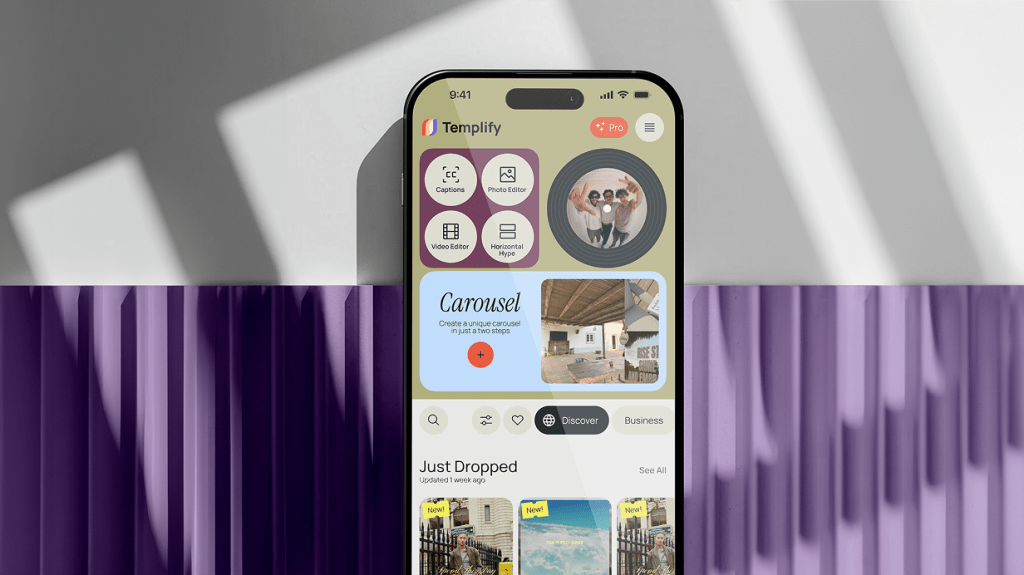
How Templify automated nearly half of customer support and cut tooling costs by 89%.
AI-native customer support and automated subscription management. 89% reduction in tooling costs, 48% of tickets fully automated, and 5.900% faster response times.


Design changes how many people get through your product and how many stay. Our UI/UX design services focus on the moments where users stall or give up.
Clear navigation keeps people moving with confidence, and they come back because using the product costs no effort.
Confusing flows push users out early. Drop-off climbs, churn follows, and you pay twice for the same customer.
A well-designed flow carries users from onboarding to the action you want, and the conversion rate holds.
Poor design loses people at the final step, after they have already decided to buy.
Intuitive, well-structured interfaces let people finish tasks faster with less thinking, which matters most in daily-use tools.
Cluttered screens slow every session. In software people use all day, those lost seconds compound fast.
Accessible design means every user can operate the product, including people who rely on a keyboard or a screen reader.
Skip it and part of your market is locked out, and the rebuild lands on you later.
Intuitive design cuts the volume of how-do-I tickets, because people find the answer on the screen.
Usability problems never stay in the product. They turn support into a permanent tax on your team’s time.
Visual design and interaction design that carry your brand, packaged as a reusable component library. This is the part of our UI/UX design services your engineers touch daily: they build from the design system instead of rebuilding buttons.
We map how people move through the product, then build interactive prototypes that show it working before development starts.
Watching people attempt real tasks surfaces the problems an internal review never catches, while they are still cheap to fix.
We set the structural blueprint of a screen: where content sits and how people navigate it without stopping to think.
We produce low-fidelity design of every page, defining content, structure, and function before anyone opens a visual tool. Wireframes settle arguments early.
A design audit of the product you already have, then a rebuild of what is actually hurting usability. We take on redesign as often as new builds.
Ekreative has put more than 250 products into the market across seventeen years, in healthcare,
finance, e-commerce and other sectors. Design ran through all of them.
AI-native customer support and automated subscription management. 89% reduction in tooling costs, 48% of tickets fully automated, and 5.900% faster response times.
AI orchestration across customer support, content moderation, and ops. Same business outcomes, 58% smaller team, fully documented handover.
AI-augmented engineering practice across architecture, code generation, testing, and review. Faster delivery on a smaller team, in a regulated healthcare environment.
Engineering velocity overhaul on a legacy codebase: AI-augmented development workflow, automated QA, and refactored architecture. Real AI in the build process — not in the pitch deck.
Tell us what you are building, or which part of your current product people keep getting stuck on. Add your timeline. A senior designer reads it, not a form.
You get a scoped response within one business day: what the work covers, roughly how long, and where we would start. No call needed before that first answer.
Time it takes to get a scoped answer from a senior designer, with no obligation to continue.
We adapt our UI/UX design services to how each sector actually operates, and shape UX design solutions around it.
Interfaces for clinicians and patients that respect compliance limits and real clinical routines.
Storefronts and checkout flows where every extra step costs you a completed order.
Ordering platforms where busy clinic staff reorder supplies in a few taps, with no time to hunt through catalogs.
Habit-forming flows that motivate without turning progress tracking into another chore.
Data-heavy interfaces that stay usable without sacrificing the trust numbers have to carry.
Long forms, claims and policy comparison made survivable through careful service design.
Operational dashboards that stay readable on the factory floor, in gloves and poor light.
Interfaces built for restricted environments where clarity matters more than visual polish.
Technician interfaces that stay usable on a phone, one-handed, in the field and offline.
We work in the standard design and prototyping tools your team already knows, and our UI/UX development services hand off in formats your engineers can open on day one.
Companies choose Ekreative when the decision goes past the portfolio. What gets checked is who runs the research and how the work adapts when scope moves. We build our UI/UX design services to survive that check.
Every layout traces back to user research — interviews, and what people actually did in your last version. Stakeholder opinion gets a hearing here. It does not get to overrule evidence about how your users behave.
AI tools speed up the production side, turning out layouts and variations faster than anyone can hand-build them. The research behind the design, and the judgment about what to build, stays with the designers on your project.
Complex products have their own design problem: multi-step workflows, several user roles, and screens dense with data that still has to stay readable. Clinical platforms, finance dashboards, B2B SaaS, marketplaces — enterprise UX at that density is the work we do most.
Some clients need a full product designed. Others want an audit of what they already have, or a designer embedded with their team month to month. The scope gets shaped around the product, not around a package we sell.
Your product gets its own design language, drawn from your users and what your business needs to happen on each screen. That is what user-centered design means in practice. No house template repainted for the next client.
From startups to enterprise teams — Ekreative helps companies ship better software faster, without sacrificing quality or reliability.
Why the difference between “more agents” and “better thinking” quietly determines whether your AI investment compounds, or stalls out The…
In the dynamic and ever-evolving landscape of healthcare, software projects play a pivotal role in enhancing patient care, streamlining operations,…
In today’s fast-paced world, the healthcare industry is constantly evolving, driven by technological advancements that have the potential to transform…
Cost depends on how much product there is to design and how much of it already exists. Screen count matters, and so does research depth. An existing design system usually brings the number down. Our UI/UX design services are scoped per project, and you see an estimate before anything starts.
Timeline depends on scope: a focused audit is short, a full product design runs considerably longer. Our user experience design services come with a written timeline once the scope is settled.
UX is how the product works, UI is how it looks and responds, and most products need both. You can have a beautiful interface people cannot navigate, or a logical structure nobody wants to look at. They get designed together here for that reason.
You get research findings, wireframes, high-fidelity screens, an interactive prototype and a documented handoff package. Accessibility requirements, including WCAG, are factored in while the screens get built. Everything arrives in formats your engineers already work in.
Yes, and it is a large part of what we do. A design audit looks at where users struggle in the product you have now, then we rebuild what is actually causing it. You can stop after the audit if that is all you need.
Yes. Responsive design is part of every screen we deliver, not a later adaptation. We design mobile-first where the product calls for it, and our UI/UX design services finish with a handoff your developers can build from. Breakpoints and states are specified, so nothing gets guessed in code.
Two ways to start. Both get a real response from someone senior — within one business day.
Book a 30-min product review
Pick a time directly on our calendar. You'll talk with a senior strategist and walk out with a written feasibility scope — even if you don't hire us.
Send us your roadmap first
Tell us what you're working on. Our sales lead, with technical input from one of our architects will review it and reply within 1 business day with concrete next steps — not a sales sequence.