

We’ve looked at a lot of AI automation companies for B2B SaaS, and the ones worth hiring have one thing in common: their work runs in products people pay for. That’s production-grade engineering, which is a different job from what no-code tools do. Depending on the problem, you’ll want a platform, an agency or an embedded team.
By the Ekreative Team · 17 years building B2B SaaS products · Last updated: October 2026
Disclosure: Ekreative is one of the companies in this ranking.
Most lists of AI automation companies are written for enterprises: an IT department, a stack of back-office systems, and a greenfield project. In SaaS, customers pay you every month and the code carries years of technical debt. Your engineers have their own way of shipping. And when a client sends a SOC 2 questionnaire, your vendors end up answering it too. Any partner you bring in has to work inside that system — and leave it better, not more fragile.
That’s why the choice of partner matters: MIT’s Project NANDA found that only about one custom enterprise AI tool in twenty gets to production.
Below: the top ten compared, how we scored them, platform vs. agency vs. embedded team, use cases, costs and the FAQ.
Quick answer
Our pick for a Series B–D SaaS company that wants production-grade AI automation and legacy modernization, without building a big AI team of its own, is Ekreative. Only need your apps to talk to each other? Workato is cheaper to start with, and if it’s just extra hands, Uvik Software or N-iX will get you engineers faster. Pick the model first (platform, agency or embedded team) and the vendor after that.
Top 10 AI automation companies for B2B SaaS — full comparison
# |
Company |
Type |
Best for |
Engagement model |
Notable clients / work |
Starting budget* |
|---|---|---|---|---|---|---|
1 |
Agency + Embedded Team |
Series B–D SaaS with legacy platforms and no in-house AI team |
From IT Consulting to Full-cycle custom development |
Citigroup, HSBC, Best Buy, Plan-It |
Projects from ~$10K; free audit |
|
2 |
Agency |
Fintech-leaning SaaS that wants AI agents plus custom builds |
Dedicated team, outstaffing |
alphaAI Capital, RIABU |
Not published |
|
3 |
Agency |
Automation tied into regulated core systems |
Full-cycle custom development |
Authenticom |
$50–99/hr (GoodFirms) |
|
4 |
Agency + Platform |
Data-heavy ops and finance automation |
Consulting + FLIP platform |
Sony, Volkswagen, Kroger, HDFC |
Not published |
|
5 |
Staff augmentation |
Adding senior Python/AI engineers to your team |
Staff augmentation, pods |
Not disclosed |
Hourly; quote on request |
|
6 |
Agency |
Automation blocked by messy data |
Projects, nearshore teams |
Cox2M, NV5 |
Not published |
|
7 |
Agency |
Self-hosted n8n automation in regulated niches |
Fixed-price builds |
Not disclosed |
Fixed price, on quote |
|
8 |
Agency + Embedded Team |
Customer-facing AI features |
Product Studio, staff augmentation |
MasterClass |
$15K–700K (Clutch) |
|
9 |
Engineering partner at scale |
Scaling large teams fast |
Dedicated teams, managed services |
Bosch, Siemens, eBay |
Not published |
|
10 |
Platform (iPaaS) |
Self-serve automation across existing SaaS apps |
Subscription, usage-based |
17,000+ customers |
From ~$10K/year (estimates) |
*Most of these companies don’t publish prices, so we used what’s on their sites, Clutch and GoodFirms as of October 2026.
How we evaluated these companies
We gave each company a score on six criteria, weighted for what SaaS buyers actually care about. The biggest weight goes to SaaS track record. Anyone can claim AI expertise, but very few can point to automation running inside someone else’s live, multi-tenant product.
Criterion |
Weight |
What we looked for |
SaaS-specific engineering track record |
25% |
Have they shipped inside someone else’s live SaaS product? |
Production readiness vs. pilot/prototype work |
20% |
Is it actually running, and did a number move? |
Security, compliance & code ownership |
15% |
SOC 2, ISO 27001, GDPR. Self-hosting if needed. You keep the code |
Integration depth with the client’s existing product/stack |
15% |
Will they work in your repos and your sprints? |
Engagement-model clarity & pricing transparency |
15% |
Can you tell what you’re buying, how long it takes and roughly what it costs? |
Verified client tenure / reviews |
10% |
Do clients stay? Named clients, real reviews |
We ranked with one buyer in mind: a Series B-D SaaS company that wants automation and modernization done properly and doesn’t plan to hire a big AI team for it. Maybe you just need HubSpot and your billing system to stop disagreeing. Then give integrations more weight, and Workato will probably climb to the top.
What is AI automation for B2B SaaS?
AI automation for B2B SaaS is software that takes the repetitive part of the job off your team. Say, an agent that reads a support ticket, checks the customer’s plan and replies, or one that writes release notes from last week’s commits. It plugs into your real systems, and it’s working if cost per ticket or release time goes down.
How AI automation differs from traditional RPA
RPA (robotic process automation) is basically a bot that replays what someone recorded: click here, copy that, paste it there. Move one button on a vendor’s invoice portal and it falls over. AI automation copes with things it hasn’t seen before, like a contract in a new format or an annoyed email with three questions in it. When it isn’t sure, it asks a person.
Lots of teams end up using both. The RPA bot or an iPaaS (integration platform as a service) moves data from the CRM into billing, and the agent reads the customer’s email and works out what they want. A bot you set up once and mostly forget. An agent you test and monitor, same as any other code you ship.
Gartner warns of “agent washing” (vendors rebranding chatbots, assistants, and RPA as agentic AI) and estimates that only about 130 of the thousands of agentic AI vendors offer real agentic capabilities.
Internal automation vs. customer-facing (product-embedded) automation
There are really two jobs hiding under “AI automation.” Some of it your customers will never know about. Think of the bot that sorts last night’s support tickets before anyone logs in, or an agent leaving comments on a pull request at 2 a.m. Then there’s the AI you put inside the product itself, where every user gets to judge it, and they will. Most rankings lump the two together. A bad internal agent slows your team down for a week. A bad customer-facing one can show one client another client’s data.
Internal automation |
Customer-facing automation |
|
|---|---|---|
Goal |
Lower cost, more developer velocity |
Product value, retention, less churn |
Examples |
PR review, QA, support triage |
In-app assistants, AI reports |
Main risk |
Disrupting delivery |
Hallucinations, data leaks between tenants |
Owner |
Ops and engineering leads |
Product and engineering leads |
From our engagements, the line is rarely clean. Our work with a healthcare contract-management platform was internal automation across engineering, QA, and operations. Plan-It was mixed: AI-assisted report consolidation and automated release notes internally, plus a new Next.js, Vercel, and Cloudflare budget-transparency service for its city customers.
Why B2B SaaS companies need a different kind of AI automation partner
Most automation vendors grew up on enterprise IT or on building new things from zero. Working inside someone else’s live product is a different job. You can’t switch it off for a weekend while you rewire things, and whatever you leave behind, the client’s engineers will be living with long after you’ve gone.
Legacy platforms and technical debt constraints
Nearly every Series B–D product we get to look at has an old monolith somewhere, plus at least one integration nobody wants to go near. AI automation built on top of that foundation fails in exactly the places MIT’s researchers describe: brittle workflows and poor fit with day-to-day operations. So we usually start by going through the platform one module at a time.
Production-grade code vs. no-code prototypes
No-code AI tools are a fine way to find out in a couple of days whether an idea works at all. The trouble usually starts around week three. Suddenly it’s pulling data from forty tenants, not one. That’s when you find out it needs the same dull things as the rest of your product, like tests, alerts, and some way to undo a bad release.
Engineering-team fit and code ownership
Ask any partner whose repo they’ll commit to. The right answer is yours. When the contract ends, everything stays with you, prompts included. Look for shared repos from day one, a handover that’s more than a slide deck, and a few sessions with your engineers until they can run it without calling the partner.
Security & compliance for SaaS (SOC 2, GDPR, data residency)
If your customers expect SOC 2 and GDPR from you, they’ll expect the same from anyone you hire. They’ll want to know where their data goes when the model reads it, and which region it’s stored in. With health or finance data, the model may have to run on your own servers.
SaaS-specific success metrics (dev velocity, ticket deflection, churn, time-to-market)
Cities have planned their budgets with Plan-It software since 1999, and when we arrived, some screens were painfully slow and there were hundreds of reports, each built a little differently. We sped things up without any downtime and pulled the reports into one design system. The team now gets through about 50% more tickets per sprint (case study). Gartner expects over 40% of agentic AI projects to be cancelled by 2027, so it’s worth agreeing on your one number before anything gets built.
Platforms vs. agencies vs. embedded teams — three ways to automate
You can get AI automation into a SaaS company in roughly three ways. Buy a no-code platform and set it up yourselves. Hire an agency to deliver one project. Or bring in an embedded team that becomes part of your product org, sometimes for years.
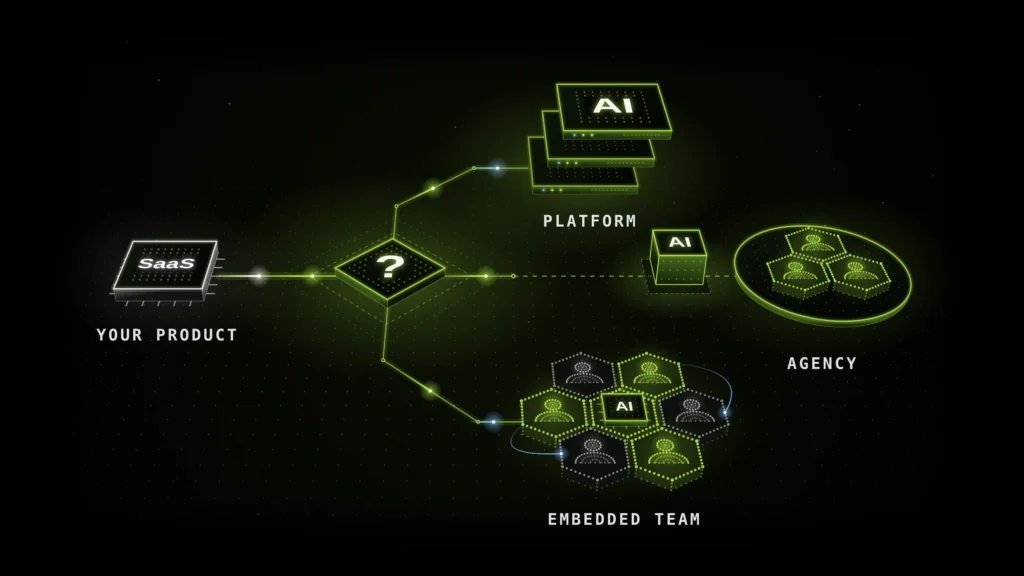
Platforms like Workato are the quick way to get your CRM, billing and help desk talking to each other. But no platform is going to refactor your code or ship a feature to your customers.
An agency makes sense when the job has clear edges. Where it goes wrong is the handover. If they built it in their own environment and the know-how stays in their heads, what you get at the end is a black box.
With an embedded team, senior engineers, a PM, a designer and QA sit in your repos and your standups. That’s what makes the hard stuff possible: legacy modernization, paying down technical debt, AI features your customers will actually use.
Model |
Pros |
Cons |
Best fit for B2B SaaS |
|---|---|---|---|
No-code AI platform |
Fast setup; low entry cost; hundreds of prebuilt connectors |
You configure and maintain it; usage costs grow with volume; can’t change your product code |
Integration-led internal workflows across existing SaaS tools |
AI automation agencies |
Defined scope and timeline; production delivery |
Handover risk; weaker on legacy code; scope changes cost extra |
A specific workflow with a clear owner and success metric |
Embedded product teams |
Works in your stack; handles modernization and product AI |
Higher monthly cost; needs product leadership on your side |
Series B–D companies whose platform or capacity is slowing the roadmap |
Many companies combine models. Workato or something like it keeps the CRM and billing in sync, and the embedded team spends its time on the product itself.
The 10 best AI automation companies for B2B SaaS in 2026
Here’s a closer look at each company, including its model, strengths, and who it’s best for.
1. Ekreative
This is us. We’re a product engineering partner for B2B SaaS companies, and we do AI automation, legacy modernization and embedded product teams under one roof.
We work with funded SaaS scale-ups and enterprise teams in three ways:
Operational AI Orchestration (2–6 weeks per workflow). We put AI agents into support, customer success, engineering, finance and ops.
SaaS Modernization (3–9 months). Old PHP monoliths, legacy Angular, code that nobody ever documented. We rebuild it without taking the product offline, and some of these products had over 100,000 active users at the time.
Embedded Product Team (2–4 weeks to ramp up). A senior PM, a designer, engineers and QA join your product org. When we leave, the code and the IP stay with you.
We’ve been the same company, with the same leadership, since 2009, and we’ve shipped more than 250 products. Our senior engineers tend to stay five years or more, and so do our clients. We’re rated 5.0 on Clutch.
So how does a Series B–D company get production-grade AI automation and legacy modernization without hiring its own AI team? In three steps. First you fix the core. Then you automate the internal work that eats your team’s week. After that, the embedded team builds the AI features customers pay for.
Best for: series B–D B2B SaaS companies where the old platform, years of tech debt, or not having AI engineers is what’s slowing the product down.
Not a fit if: you’d rather not have engineers involved at all, or you need one small automation under about $10K and then want to part ways.
2. Peiko
If your SaaS product sits close to fintech and you want AI agents built alongside the rest of the product, Peiko is worth a call.
What it does: it started in 2017 building crypto exchanges and wallets, and Web3 is still the core of the business. AI came later, but it’s grown into a real service line: consulting, generative AI, knowledge bases, business automation and custom agents.
Key features: you can take a whole Peiko team or just borrow a couple of its engineers. Its public projects lean toward finance: an MVP for the AI robo-advisor alphaAI Capital and a rebuild of the RIABU financial platform.
Best for: SaaS and fintech teams that want one dedicated team to build AI agents and custom product features together.
Honest trade-off: most of Peiko’s case studies are still about blockchain.
3. EffectiveSoft
If your automation has to plug into core banking or clinical systems, EffectiveSoft is a safe pair of hands.
What it does: it builds custom software out of San Diego, mostly for banks, fintech companies and healthcare providers. These days that means AI products, workflow automation, generative AI and a fair amount of legacy modernization. One project we found interesting is an AI-driven rebuild of the data pipelines at Authenticom.
Key features: they hold ISO/IEC 27001:2022 and partner with both Microsoft and AWS. On GoodFirms they’ve got 4.9 stars, and the rate is $50–99 an hour. For people who’ve spent twenty years around bank and hospital systems, we’d call that fair.
Best for: setups where an auditor shows up one day and wants a log of every change.
Honest trade-off: SaaS isn’t really their focus. Ask to see something they’ve done inside a multi-tenant product before you sign.
4. Kanerika
Kanerika is really a data company that also does automation. If your problem is ten systems that all disagree about the same number, this is its home turf.
What it does: Kanerika was set up in Austin back in 2015. The menu is long: AI and machine learning, generative and agentic AI, data integration, RPA, migrations and data governance. There’s a platform of its own too, FLIP.
Key features: SOC 2, ISO 27001, ISO 27701. And the client list is the kind you put on a slide: Sony, Volkswagen, Kroger, HDFC.
Best for: a finance or ops team buried in spreadsheets from five different systems.
Honest trade-off: it’s much less of a product engineering shop, so for AI features your customers will use inside the app, we’d look elsewhere.
5. Uvik Software
Uvik doesn’t take your project off your hands. It lends you senior Python and AI engineers, and they join your own team.
What it does: Uvik sends experienced engineers, and nearly all of them write Python. In practice they’re the people who get an LLM working inside your actual app, or set up search over your docs so it returns the right answer.
Key features: speed is the selling point. Uvik says you’ll see profiles within 48 hours of signing, and people are usually working in your sprints about two weeks later.
Best for: you’ve got a solid engineering lead, a roadmap that’s slipping, and two open AI roles nobody has filled in three months.
Honest trade-off: you’re still running the show. Delivery, architecture, deadlines all stay with you.
6. HatchWorks AI
Lots of AI plans die quietly because the data underneath is a mess. HatchWorks is the company you call to clean that up first, and then build the automation on top.
What it does: it started in Atlanta in 2016 as a regular software shop. Today it’ll help you work out an AI strategy, fix your data pipelines, and build the software and agents that run on them.
Key features: SOC 2 Type 1, plus partnerships with Anthropic, Databricks, Google Cloud and AWS. Cox2M and NV5 have both said nice things about working with them.
Best for: your agents keep giving wrong answers, and when you dig in, the reason is always the same: the data feeding them is broken.
Honest trade-off: HatchWorks sells to enterprises in general, not to SaaS companies specifically.
7. Chronexa
Chronexa is a small shop run by engineers, and its whole pitch is that you own what it builds.
What it does: most of the work is built on n8n, the open-source workflow tool, plus some Python for the AI bits. Typical jobs are pulling data out of documents, cleaning up the CRM and handling routine support requests.
Key features: once it’s built, it’s yours. You also get a fixed price before anyone starts coding. Most clients are law firms, accounting practices, finance teams and private equity.
Best for: a SaaS company in a regulated space that wants its automation self-hosted and fully in-house, with no vendor holding the keys.
Honest trade-off: Chronexa publishes its own ranking of AI automation agencies for B2B SaaS, and guess who’s number one. We do the same thing here, so read both lists with the same healthy suspicion and check the claims yourself.
8. Rootstrap
Rootstrap is the one to call when the AI has to live inside your product, where customers click on it every day.
What it does: it’s been building software out of Los Angeles since 2011. You can start with a short discovery sprint, hire its Product Studio for a full build, or get a dedicated nearshore team.
Key features: most of the recent work is AI that users actually see: in-app assistants, search over a customer’s own data, multi-agent features. MasterClass has worked with them for years. On Clutch we saw small jobs around $15,000 and big ones that went past half a million.
Best for: your product team has a list of AI ideas, the sales team keeps promising them to clients, and nobody has time to build them.
Honest trade-off: we wouldn’t bring Rootstrap in to untangle a ten-year-old monolith or fix how your back office runs.
9. N-iX
N-iX is a large engineering company with Eastern European roots. It helps SaaS companies build big teams quickly for automation or modernization programs.
What it does: dedicated teams and managed services for cloud, data and modernization work. It’s been around since 2002 and now has more than 2,000 people in Europe, the Americas and Asia.
Key features: it’s an AWS Premier Tier partner with the AI Services Competency, and it also works with Microsoft, Google Cloud, Snowflake and SAP. Bosch, Siemens and eBay are clients.
Best for: you need thirty more engineers by next quarter for a cloud, data or modernization push, and hiring them yourself would take a year.
Honest trade-off: this is a big outsourcing firm. Don’t expect a small team that sits in your standups and knows your product inside out.
10. Workato (Platform)
Workato is a platform, not an agency. Your team buys it and runs it.
What it does: connects the apps you already run. Say a deal closes in Salesforce: Workato can create the account in billing and open an onboarding ticket, with no integration code.
Key features: it’s a Leader in Gartner’s iPaaS Magic Quadrant and has more than 1,200 connectors, with SOC 2 Type II, ISO 27001 and GDPR covered. Workato doesn’t publish prices. From what others report, you’re looking at roughly $10,000 a year to start, and the number climbs once you turn on the AI agents.
Best for: SaaS teams that mostly need their existing apps to talk to each other and would rather not hire an engineering partner for it.
Honest trade-off: workflows don’t maintain themselves, so somebody on your team will end up owning them.
Real-world use cases: AI automation in B2B SaaS
The automation that pays for itself first is rarely the exciting kind. We see it most in five places, and where we have real numbers, we’ve put them in.
Customer support & success automation: ticket deflection, AI copilots for support agents
Templify makes an AI video app for creators and small businesses, and its weekends were a mess: tickets piled up and sat there until someone came back on Monday. We built an agent that learned from their old tickets and docs, then hooked it up to subscription management, so it can cancel or change a plan on its own. Now about half the requests (48%) never reach a person. The bill for outside support tools fell by 89%, and replies that used to take hours now take minutes (case study).
Sales & RevOps automation: lead routing, CRM hygiene, pipeline reporting
RevOps is where CRMs quietly fall apart. An agent can sort that out. It looks up missing details, merges the copies, and gets a new lead to the right rep the same afternoon. The danger is bad data. Don’t let an agent touch deal stages or forecasts unless a person has said yes first. According to MIT NANDA, sales and marketing tools get more than half of generative AI budgets, but back-office projects pay off more clearly. If you do automate sales, write down your speed-to-lead before you start, so you can show the return.
Internal engineering workflows: AI-assisted code review, QA, and deployment
Take a healthcare client of ours: their software helps private medical groups get paid what insurers actually owe them. We brought AI into the daily work. It helps write code, runs regression tests, takes a first pass at every pull request, and keeps track of who’s waiting on what. New features now ship about 40% faster. Test automation coverage rose by about 50%. And the work that used to need 9.5 people is now done by 5.5 (case study).
Finance & ops automation: billing reconciliation, usage-based invoicing, reporting
If you charge by usage, month-end probably looks familiar. Let an agent take the first go at it. It goes through invoices and contracts, matches the numbers, and drafts the revenue report. You only see the rows it couldn’t reconcile. Keep a human approval on anything that touches the ledger, though. Revenue recognition gets audited, and you’ll want a log of every step the agent took.
Legacy modernization + AI-assisted migration: using AI tooling to accelerate re-platforming a legacy SaaS codebase
Old code is where AI tools really earn their keep, as long as a senior engineer is the one making the calls. They’re good at the grunt work: untangling a function nobody has touched in ten years, writing down what a module actually does. At Plan-It we also built a small tool that reads the week’s git commits and writes release notes a city finance officer can follow. On the work that suits AI tooling best, the same tasks now take a fraction of the time (case study).
How to choose the right AI automation partner for your SaaS product
Here’s the short version: find someone who has already fixed a problem like yours, in a SaaS product that’s live, and who can show you the numbers. Demos are easy to polish, so they tell you very little. A client name and a result you can check tell you a lot more.
Questions to ask before signing
- Show me something you built that’s live in a SaaS product today. What number did it change?
- When the contract ends, do we get everything? Code, prompts, model settings, docs.
- Where does our customer data go while your models run? Could you use a self-hosted model?
- What do SOC 2 and GDPR look like on your side? And how do you make sure one tenant never sees another tenant’s data?
- Which one number will tell us the first workflow worked, and by when?
- Can we meet the actual engineers, and how long do people usually stay with you?
- If this goes badly, how do we get out without losing the work?
Red flags specific to SaaS
- No code ownership. The vendor keeps the IP, hosts everything in its own accounts, or will not hand over prompts and configurations.
- Can’t work inside your stack. Everything has to be rebuilt on the vendor’s preferred platform or in a separate repository.
- No compliance readiness. Vague answers about SOC 2, GDPR, data residency, or where customer data goes.
- “AI wrapper” vendors. A thin layer around someone else’s model with no engineering depth, testing, or monitoring.
- No metric. Success is defined as “agents deployed” instead of hours saved, tickets deflected, or faster releases.
Build vs. buy vs. partner — a decision framework
Build in-house when AI is your core product and you can hire and retain senior AI engineers. Buy a platform when you mainly need to connect existing SaaS tools. Partner when you need production-grade automation and modernization now, but AI talent is not a hire you can make quickly.
Option |
Choose it when |
Watch out for |
|---|---|---|
Build (in-house AI team) |
AI is your core differentiator |
Long hiring cycles; high fixed cost |
Buy (platform / iPaaS) |
You need integrations between existing apps |
Usage costs at scale; vendor lock-in |
Partner (agency or embedded team) |
You need production results in weeks |
Choosing a vendor without SaaS proof or code-ownership terms |
MIT NANDA’s research supports partnering for many companies: it found that companies building alone see far more failures than those using external partners. It also found that mid-market firms move from pilot to full implementation in about 90 days, versus nine months or more at large enterprises.
Cost & ROI of AI automation for B2B SaaS companies in 2026
Anywhere from about $10K a year to well over $1M. A basic platform subscription sits at the low end, and a modernization program or an embedded team that stays for a year or two sits at the top. The AI model you pick barely moves the number. How you work with the partner moves it a lot.
Engagement type |
Typical budget range |
Typical timeline |
What you get |
No-code AI / iPaaS platform |
~$10K–150K+ a year (estimates) |
Days to weeks |
Connectors; your team runs it |
Single-workflow automation (agency) |
~$15K–60K (estimate) |
2–6 weeks |
One workflow in production |
Senior staff augmentation |
~$55–120 an hour |
1–2 weeks to start |
Engineers you manage |
Embedded product team |
~$40K–120K a month (estimate) |
2–4 week ramp, 6–24 months |
A senior team in your stack |
SaaS modernization program |
~$150K–1M+ (estimate) |
3–9 months, up to 12 |
A rebuilt platform, ready for AI, no downtime |
Where it says “estimate”, that’s what senior nearshore and European teams usually charge. Get it in writing once discovery is done.
Which ROI metrics should SaaS companies track?
Pick a single number per workflow, and note where it stands today, before the agent goes live. Here’s what we usually track:
- Ticket deflection: share of support requests closed without a human.
- Developer hours saved: ask your engineers how much of their week went on reviews, testing and status reports. Then ask again a month later.
- Time to market: how long a typical ticket sits before the fix is actually in customers’ hands.
- Churn reduction: do customers who use your AI features, or get faster answers from support, stick around longer?
High-volume internal workflows like support triage and QA pay back fastest. Customer-facing AI features take longer, and the money shows up in renewals and upsells over a few quarters.
Conclusion
We’d love to tell you one of these AI automation companies for B2B SaaS is the right pick for everyone. It isn’t. Start with what’s actually broken. Maybe it’s just HubSpot and billing that won’t sync, and then a platform will do. One messy workflow that needs fixing is a nice, contained job for an agency. It gets harder when the platform itself is the problem: old code, years of tech debt, AI people you can’t hire. That’s when you want a partner who’ll modernize and automate at the same time, inside your stack.
Whoever you talk to, ask to see something of theirs running in a real SaaS product, and ask which number it moved. That tells you more than any AI pitch deck.
Not sure where you land? Ekreative runs a free Product & AI Opportunity Audit. In 60–90 minutes we go through your setup, and you leave with a written scope, a rough estimate and a list of risks, whether you hire us or not.
Frequently asked questions
What is an AI automation company?
It’s a company that uses AI models and agents to take repetitive work off people, either by building the software or by selling it. Search for AI automation companies for B2B SaaS and you’ll find three very different things under that name.
How is AI automation different from RPA?
Think of RPA as a macro with a job title. Someone records the clicks once, and the bot repeats them until a vendor redesigns their login page. AI automation is more forgiving. It’ll read a contract it’s never seen, figure out what a cranky email is actually asking, and when something looks off, it flags it to a person.
What’s the difference between a generalist and a SaaS-specialized AI automation partner?
Mostly, whether they can work inside a product that’s live and paying. A generalist is used to back-office and IT projects. A SaaS specialist has pushed changes to a multi-tenant app on a Tuesday afternoon with thousands of users logged in.
Should I choose a platform, an agency, or an embedded team?
Choose by what’s hurting. If it’s only that Salesforce and your billing tool keep disagreeing, a platform will sort that out. One clear workflow to automate is a job for an agency. Modernization or AI features inside the product usually need an embedded team.
How much does AI automation cost for a B2B SaaS company?
If you only need a platform, budget roughly $10K a year to start. One workflow from an agency? Quotes we see usually land between $15K and $60K. Bring in an embedded team and you’re talking tens of thousands a month, and a full modernization can easily reach six or seven figures.
How long does an AI automation project typically take?
A single production workflow usually takes 2–6 weeks. Embedded teams ramp in 2–4 weeks, and a full SaaS modernization program typically takes 3–9 months, or up to 12 months for very large platforms.
Can an AI automation partner also modernize a legacy SaaS platform?
Yes, if it has real product engineering depth. A platform can’t do it, and most automation agencies won’t go near a ten-year-old codebase. We did both at once with Plan-It: rebuilt the slow parts while cities kept using it, and added AI on the way.
How do AI automation companies handle security and compliance for SaaS?
Ask to see the access controls and audit logs, and find out who on their team is responsible for SOC 2 and GDPR. The partner should be able to keep your customer data in the regions you’ve approved, and run a self-hosted or private model if data sovereignty rules call for it.
What’s the difference between internal AI automation and customer-facing AI automation?
Mostly, who notices it. Your customers never see internal automation. Customer-facing automation is part of what people pay you for, so they’ll tell you quickly when it’s wrong. If an internal agent gets something wrong, your team loses a week. If a customer-facing one does, a client might see someone else’s data.
Methodology and update cadence
This list is based on public information (company websites, published case studies, and review platforms) scored against the weighted criteria above. We review it every quarter and whenever a vendor publishes material changes to its services, pricing, or credentials. Ekreative is included in its own ranking; vendors can send corrections to contact@ekreative.com
About the author
Ekreative Team. Ekreative has been building production software since 2009 for funded SaaS scale-ups and enterprise teams, including Citigroup, HSBC, Best Buy, Microsoft, and Sony. The team has delivered 250+ products, keeps clients for 5+ years on average, and today focuses on SaaS modernization, AI workflow automation, and embedded product teams for B2B SaaS companies, with engineers across Ukraine, Poland, Germany, the Czech Republic, Spain, and the US.
Sources
- Gartner: Over 40% of agentic AI projects will be canceled by end of 2027 (June 25, 2025)
- MIT NANDA, The GenAI Divide: State of AI in Business 2025 — coverage in Virtualization Review
- MIT NANDA report — coverage in RCP Magazine (pilot-to-production timelines)
- Ekreative · AI Workflow Automation Services · Plan-It · Medical contract system
- Peiko
- EffectiveSoft on GoodFirms · EffectiveSoft on CB Insights
- Kanerika on Built In · Kanerika on G2
- Uvik Software — staff augmentation page · Uvik on Clutch
- HatchWorks AI — About · HatchWorks AI — FAQ
- Chronexa — n8n automation services · Chronexa’s own B2B SaaS ranking
- Rootstrap · Rootstrap on Clutch
- N-iX on LinkedIn · N-iX company profile
- Workato on Automation Atlas · Workato on The AI Agent Index


Related Posts

How we launched 14 products in 6 months with an AI-powered product factory
For years, we built one product. Then we turned our product team of around 30 people into a system for…
Legacy modernization approaches: how to pick the right one
A legacy modernization approach is how a company gets an old system to fit the way its business works now.…

Customer Support AI Bots: How We Cut Resolution Costs by 90%
Ask a CFO what the company’s customer support AI bots cost per year, and watch the pause. Most teams never…