

For years, we built one product. Then we turned our product team of around 30 people into a system for AI-powered product development and launched 14 products in six months. Here’s how we tested each idea on $250 of ads, built MVPs in 2 to 3 weeks, and chose what to scale.
Key takeaways
The short version, in five points:
- We ran a $250 Meta ad test on every idea before coding.
- Top concepts reached up to 40% pre-registration at around $3 per lead.
- With AI tools, one developer usually built an MVP in 2 to 3 weeks.
- We based rapid product development on one shared infrastructure.
- After launch, we typically put $5,000 to $10,000 into ads before deciding a product’s future.
The challenge: Growing beyond a single product
We had to find out if one team could launch many products instead of betting on one. Our team had spent years on a single product. We knew it inside out. We hit the same wall whenever someone came up with a new idea. We could only test it by borrowing people and money from the main product, so tests were slow, expensive, and rare. We saw a multi-product strategy as the answer, but only if our existing team could run it. That’s why we turned to AI-powered product development.
Rethinking product development
We rethought product development by changing what our team did, not who was on it. Everyone stopped working toward one roadmap and started bringing ideas. To find them, we tracked market trends and hunted for problems with quick solutions. We judged each idea on two questions. Could we build it fast, and would people pay for it? Our CEO reviewed the shortlist, and we ended up with a prioritized backlog of future products. From there, we switched to a product factory model and used AI in software development for the repetitive parts.
Step 1: Validating demand before writing code
We validated demand by putting a landing page and a small ad budget in front of real users before anyone wrote code. We didn’t want to spend engineering hours on guesses. So we built a page for each concept from reusable templates and wrote the copy with AI help. Then we spent $250 on Meta ads per page. We watched two numbers. From cost per lead (CPL), we learned how cheaply we could attract people. The conversion rate, meaning the share of visitors who pre-registered, was our measure of real demand. We made this the first gate of our AI-powered product development, and every idea had to pass it. The strongest pages converted up to 40% of visitors, with leads costing around $3. We dropped weak ideas here, before MVP development. So we spent far less time building products nobody wanted.
Step 2: Building MVPs in 2–3 weeks with AI
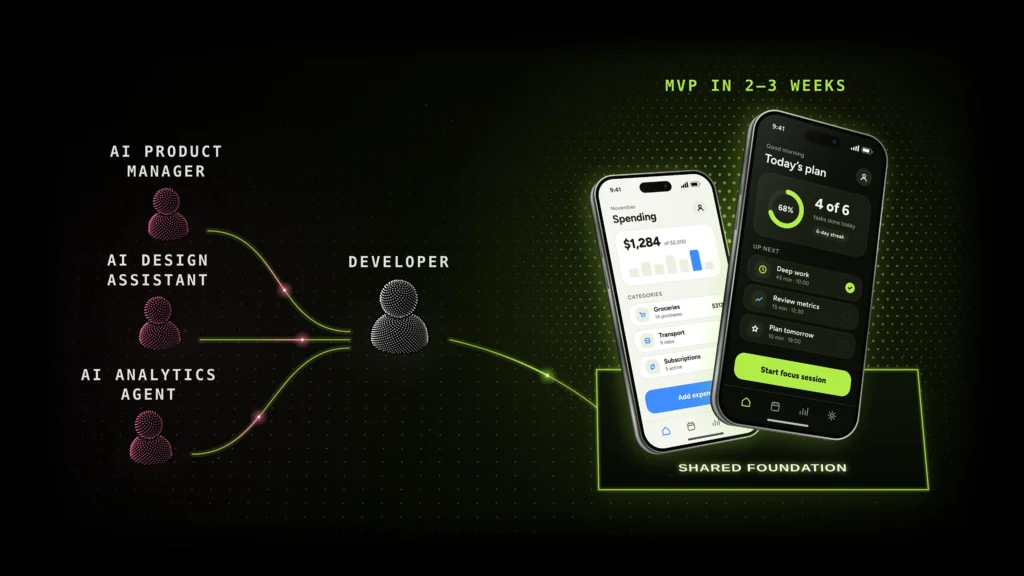
We usually got an MVP out in 2 to 3 weeks with a simple setup: one developer per product, backed by AI. For rapid MVP development, we stopped assigning large teams. Each MVP had four roles in its pipeline:
- AI product manager for product flows and specifications.
- AI design assistant for first UI concepts and design assets.
- AI analytics agent for analytics built into every project.
- a developer who assembled the product with AI coding tools.
We ran all AI-assisted coding on one shared technical foundation, so nobody started from zero. We gave every product the same architecture, onboarding patterns, subscription flows, analytics setup, and coding standards. That paid off quickly. If we fixed a UX issue in one product, we could apply the fix everywhere else right away. Every new product made the next one easier to build, which is the whole point of AI-powered product development.
Step 3: Launching and deciding what to scale
After a mobile app launch, we started paid campaigns right away and decided what to scale based on real numbers. We ran user acquisition through Apple Search Ads and Meta, usually with $5,000 to $10,000 for the first round. We then sent each product down one of three paths:
- Stop: we shut down products with little interest or unsustainable acquisition costs.
- Iterate: if demand was real but purchases cost too much, we worked on paywall optimization, onboarding, pricing, and UX before the next test.
- Scale: only products with strong market potential got more budget.
Not every product took off. Because we had set clear metrics in advance, we could make these calls early.
AI beyond development: Our internal analytics agent
We took AI-powered product development past the codebase by building an internal analytics agent for the whole team. We connected it to our Git repositories, Google Analytics, payment systems, and App Store and Google Play data. Now anyone on the team can ask it about any product and get an answer. We also use it to build analytics funnels and spot performance trends. When we need a deeper look at business metrics, we start there too. We even automated our App Store and Google Play review replies with it. The result is simple. We see how each product performs much sooner, so we make app portfolio strategy calls faster.
The results: 14 products in 6 months
In six months, we tested dozens of product ideas and launched 14 new products. Results varied. Some gained traction almost at once, some needed more rounds of changes, and a few fell short of our targets. The fourteen, ranked by how they have performed so far — several are still early:
- Workout Locker (iOS and Android)
- Chore Reward (iOS and Android)
- GuardianView (Android)
- Screen Free (iOS)
- Family Map (iOS)
- Talk Deck (iOS)
- No Screens Game Club (iOS)
- Sketch Tales (iOS)
- Matharoo (iOS)
- Parenting Guide (web)
- SafeWeb Browser (iOS)
- Meditaura (iOS)
- My Family Album (iOS)
- SubGate (iOS)
With them, we now have an app publishing model based on AI-powered product development.
Key numbers at a glance
Here is the whole process in six numbers:
Metric |
Result |
Products launched |
14 in 6 months |
Idea test budget |
$250 per landing page |
Best pre-registration rate |
up to 40% |
Cost per lead |
around $3 |
MVP build time |
usually 2 to 3 weeks |
First launch ad budget |
typically $5,000 to $10,000 |
In other words, an idea that failed early cost us $250 in ads, not a launch budget.
Lessons learned
Our main lesson is that cheap experiments matter more than any single launch. Once we knew how to find ideas, test demand, build MVPs, and measure results, a new product became routine work. Failed products cost us little and taught us a lot. Every fix and every insight carried over to the next launch. We now see scaling product development as a matter of process, not headcount. Going forward, we work like a publisher, and each successful product makes the whole portfolio stronger.
Want to build your own product factory?
If you have more ideas than your team can test, we can help you set up the same process. We’ll look at your product, your team, and your goals, then show you where cheap validation and AI-assisted MVPs could save the most time. The first call is free.
Frequently asked questions
How long does it take to build an MVP with AI?
With AI-powered product development, one of our developers usually builds an MVP in 2 to 3 weeks. Knowing how to build an MVP with AI is only half of it. The other half is a shared foundation we reuse for every product.
How do you validate a product idea before development?
We build a landing page for the idea and spend $250 on Meta ads to see who pre-registers. We then check two numbers: cost per lead and the share of visitors who pre-register. If the numbers are weak, we don’t write any code.
Can this model work for other companies?
We think so. Very little of it depends on our products or market. You need a team that keeps coming up with ideas and is fine with dropping many of them. The budgets and timing will be yours to set.


Related Posts

Legacy modernization approaches: how to pick the right one
A legacy modernization approach is how a company gets an old system to fit the way its business works now.…

Customer Support AI Bots: How We Cut Resolution Costs by 90%
Ask a CFO what the company’s customer support AI bots cost per year, and watch the pause. Most teams never…

Top 10 AI automation companies for B2B SaaS in 2026
We’ve looked at a lot of AI automation companies for B2B SaaS, and the ones worth hiring have one thing…